
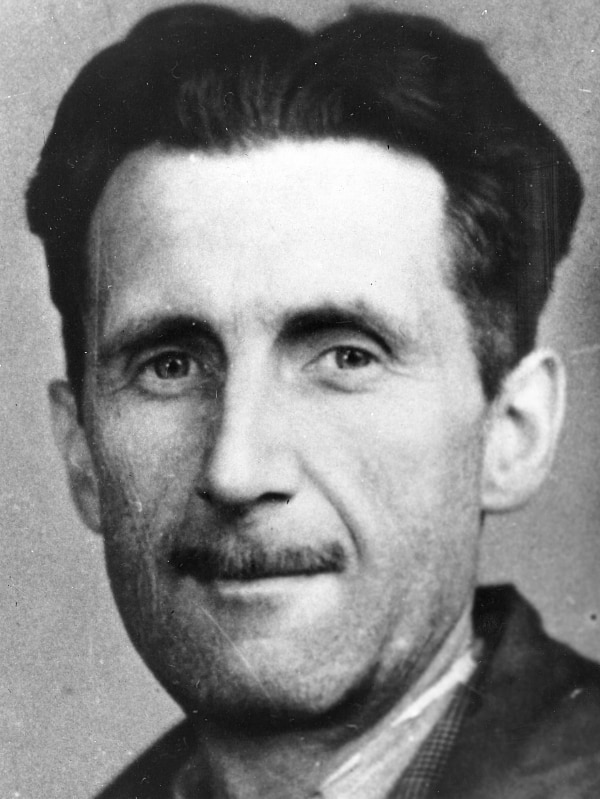
George Orwell was born Eric Arthur Blair in 1903 in India and educated at Eton College until 1917. In 1921 he served in the Imperial Police of Burma which inspired his first novel Burmese Days eventually published in 1935. From 1930, he worked as a schoolteacher, private tutor and bookshop assistant while writing articles and reviews for several publications. His second book (but first to be published) Down And Out In Paris And London was written under his new pseudonym George Orwell in 1933.
Commissioned in 1936 to visit areas of mass unemployment in Lancashire and Yorkshire to write The Road To Wigan Pier – a passionate study of the plight of the jobless, published in 1937, followed by Keep The Aspidistra Flying. In late 1936, Orwell join the Republican POUM militia in the Spanish Civil War where he was seriously wounded by a bullet to the throat.
Orwell returned again to England in 1938, escaping from Spain through the Pyrenees. His next book, Homage To Catalonia, recorded his experiences. In 1939, in Morocco, he wrote Coming Up For Air, – a defence of the individual against big business. During the remainder of World War II he served in the Home Guard and broadcast for the BBC Eastern Service and from 1943 onwards he also worked freelance for The Observer and Manchester Evening News. Finally, he took a post as Literary Editor of The Tribune where he regularly contributed political commentary. The death of his first wife in 1945 coincided with the publishing of Animal Farm which brought him immediate international recognition. His final and equally notorious parable illustrating his dislike of totalitarianism, Nineteen Eighty Four, was published in early 1949. At this time he was taken seriously ill with tuberculosis and, in January 1950, shortly after marrying Sonja Bronwell, he died… Animal Farm and Nineteen Eighty Four have since been translated into over one-hundred languages. Animal Farm remains one of the highest selling paperbacks of all time.